How to Choose the Perfect Cosmetic Mixer
The perfect lipstick glides on smoothly. The ideal face cream leaves a flawless finish. A great blush leaves the wearer … blushing.

Explore our full range of process equipment engineered for precision, performance, and durability. From industrial mixers and stainless steel tanks to custom mixing systems and mills, we deliver scalable solutions for every stage of your production process.


From air pollution control to advanced water treatment, Branch Environmental by MXD Process delivers engineered systems that help you meet environmental regulations and operational goals.

MXD Process offers end-to-end services—from custom fabrication and engineering to automation, lab testing, and equipment refurbishing—to bring your process to life and keep it running smoothly.

Access MXD Process resources including blogs, technical guides, manuals, and maintenance tips—everything you need to optimize, troubleshoot, and expand your process knowledge.
5 min read
Scaling a process from the lab to production sounds straightforward until downtime increases, batches become inconsistent, or product starts getting scrapped during scale-up.
At 50 gallons, your product may blend perfectly. At 500 gallons, you suddenly see inconsistent viscosity, temperature variation, poor dispersion, or longer cycle times. The mixer still runs. Nothing appears broken. But the overall industrial mixing system isn’t working the way it should.
That’s because industrial mixing systems aren’t just mixers. They’re complete industrial process systems made up of the tank, agitator, controls, and process requirements all working together.
When one part of the system is mismatched, the rest of the equipment can’t compensate.
Most mixing issues don’t come from equipment failure. They come from an incorrect system design.
That often shows up as inconsistent batches, excessive cycle times, operator workarounds, or production bottlenecks that slowly reduce throughput and efficiency over time.
A mixer that performs well in one tank geometry may struggle in another. An agitator selected for low viscosity conditions may lose effectiveness as the product thickens. A process that works manually at pilot scale may become inconsistent without automated controls at production scale.
These problems usually don’t show up on paper. They show up after installation, during production, when downtime becomes expensive.
That’s why specifying industrial process equipment requires a system-level approach from the beginning.
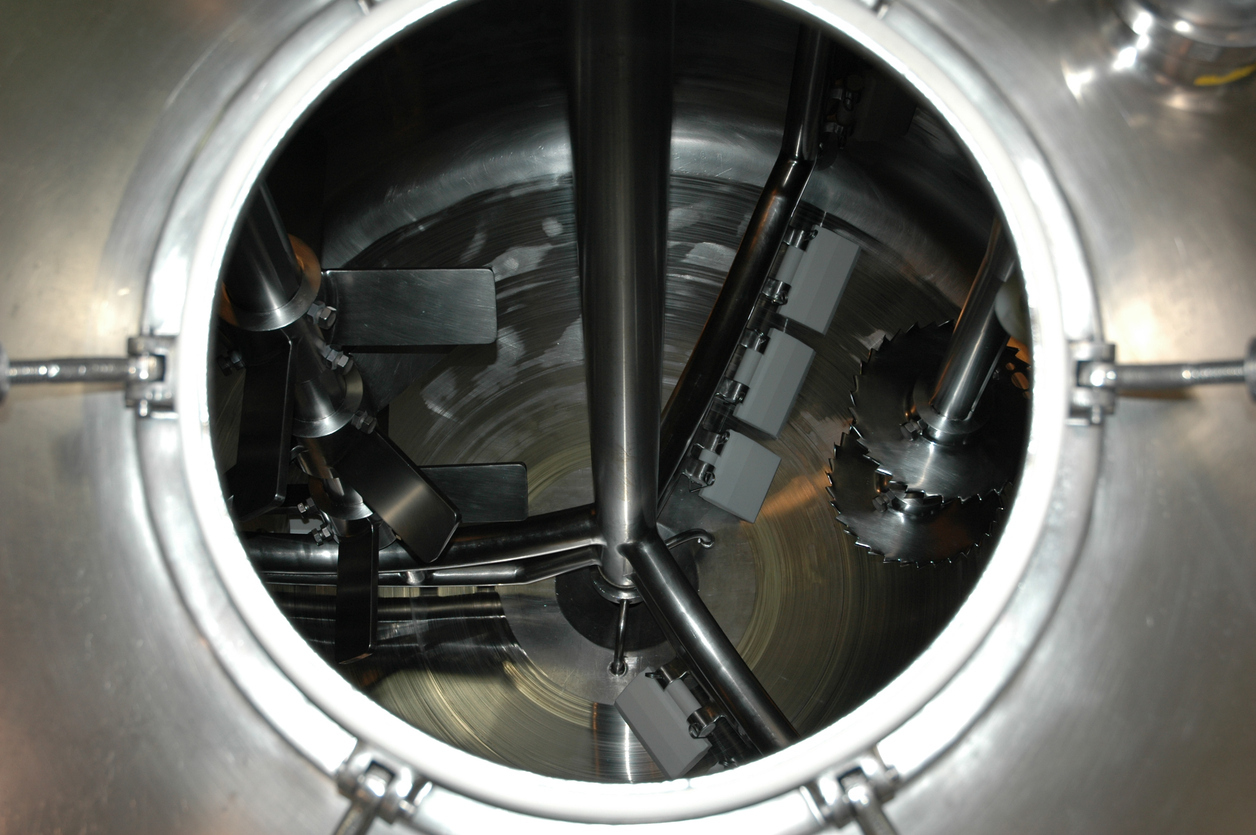
The tank does far more than hold product. It directly affects flow patterns, mixing efficiency, heat transfer, and overall batch consistency. In many industrial mixing systems, tank design has just as much impact on performance as the agitator itself.
That’s why tank geometry should be addressed early in the specification process, not treated as a secondary decision.
For most low-to-medium viscosity applications, cylindrical tanks with cone or dished bottoms provide reliable fluid circulation and efficient product turnover.
Internal baffling is also important because it:
Without proper baffling, much of the agitator’s energy can be wasted simply spinning the batch instead of creating useful mixing action.
Material selection matters too, especially in sanitary industries like food, beverage, and pharmaceutical manufacturing. Surface finish, drainability, and fitting styles all influence cleanability and compliance requirements. Features like tri-clamp connections, polished welds, and proper drain angles are much easier to incorporate during the original design phase than after fabrication begins.
If your process requires heating or cooling, the tank design becomes even more important. Jacketed vessels allow temperature control through the tank wall, but the heating or cooling method must align with the process itself. Steam, glycol, and hot water systems all perform differently depending on cycle times, viscosity, and thermal sensitivity.
Getting the tank specification right early helps ensure the rest of the industrial process equipment performs the way it’s supposed to once production starts.
This is where most of the specification work happens, and it's also where the most mistakes are made. One of the most common mistakes in industrial mixing system design is starting with motor horsepower.
The better place to start is fluid behavior.
Viscosity is the single most important fluid property. Low-viscosity fluids (think water-like, under 1,000 cps) move easily and respond well to axial-flow impellers, which push fluid vertically through the tank to create strong top-to-bottom circulation.
Higher viscosity fluids need more torque and often perform better with radial-flow or anchor-style impellers that move material outward and across the vessel wall to maintain turnover in thicker products.
Take a real example: a specialty adhesives manufacturer running a batch that starts thin (around 500 cps) and builds to 20,000 cps as the reaction progresses. An impeller sized only for the starting viscosity will stall or underperform as the batch thickens. The right spec accounts for the full viscosity range across the batch cycle, not just the starting point. This is also where motor and gearbox selection gets more nuanced, because you need enough torque to handle peak load, not just average load.
In addition to fluid behavior, shear sensitivity and mounting configuration should be considered when choosing the right mixer.
Some products need high shear to disperse pigments, break down agglomerates, or emulsify oil and water phases. Others are shear-sensitive and will degrade if you push them too hard. A rotor-stator high shear mixer is not the right tool for a shear-sensitive polymer, no matter how capable the equipment is.
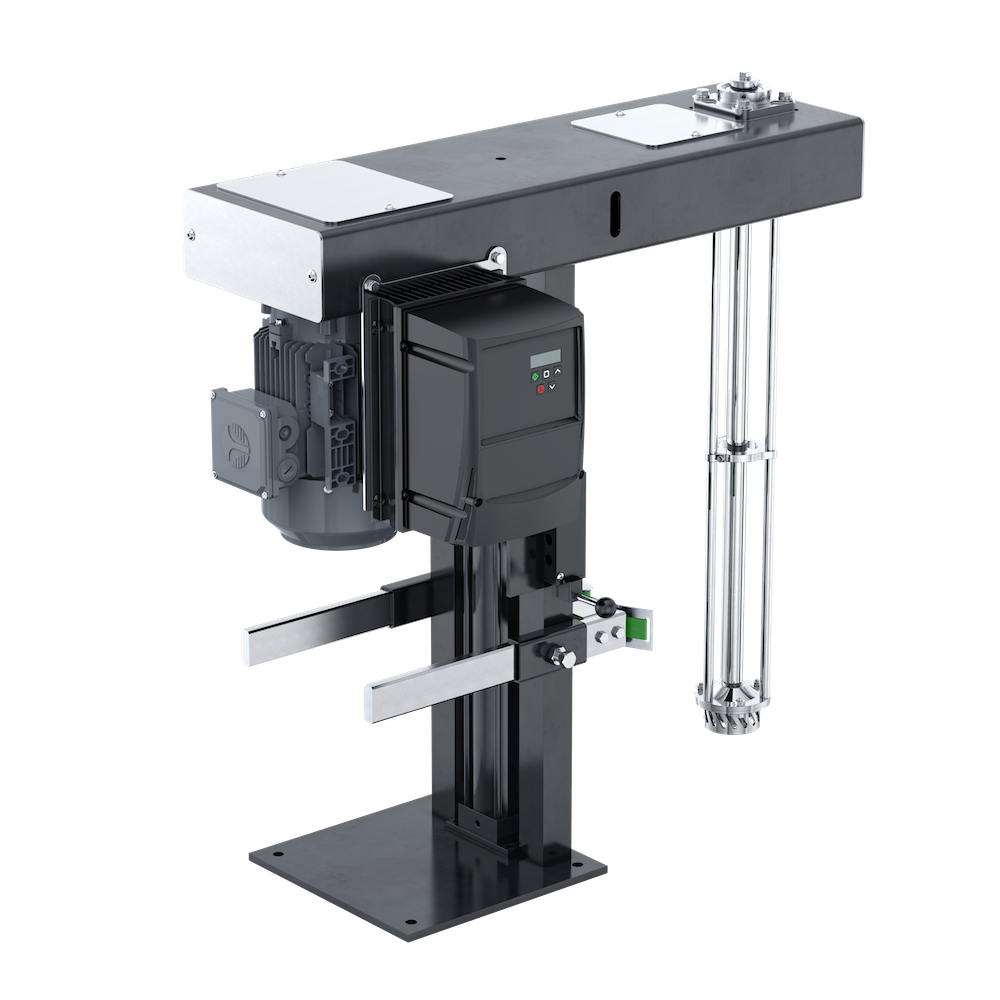
Impeller type and mounting configuration both follow from this. Shaft length, bottom clearance, and whether the mixer is top-entry, side-entry, or portable all affect performance and need to be matched to your tank geometry.
If you're sorting through these variables and want a second set of eyes on your application, our engineering team at MXD Process is happy to help. We can review your fluid properties and process requirements before you commit to hardware.

Process control is often treated as a separate decision, added after the equipment is already specified. That's usually a mistake.
The level of control you need depends on what your process actually requires. Some mixing applications run at a fixed speed, simple on/off operation. Others require ramping speed up or down during the batch, sequencing multiple operations (mix, heat, hold, discharge), or integrating with upstream or downstream equipment. Specifying a mixer without knowing how it needs to be controlled can create a situation where the equipment is capable but the control architecture can't get the best out of it.
A variable frequency drive (VFD) can improve process flexibility by allowing operators to adjust agitation speed throughout the batch cycle. This helps reduce startup load, improve shear control, and minimize air entrainment during finishing stages.
More advanced industrial process equipment may include:
Integrating these controls during the original system design is significantly easier than retrofitting them later.
A system may appear properly sized on paper, but once production begins, issues like poor circulation, inconsistent blending, or long batch times start showing up. Understanding the most common specification mistakes early can help prevent expensive problems later on.
Your system needs to handle worst-case viscosity and peak load conditions, not just ideal operating points.
The tank, agitator, and controls all influence one another. Industrial mixing systems should always be designed together.
Processes that work at pilot scale often behave differently at production volumes due to changing fluid dynamics and heat transfer behavior.
Surface finish, seal selection, and wetted materials affect compliance, cleanability, and long-term maintenance.
Discovering late in the project that automation or sequencing is required can create major redesign costs.

When the tank, agitator, and controls are designed around the actual process requirements, the result is a more predictable and efficient operation.
A properly specified industrial mixing system helps improve:
Instead of reacting to production problems later, the system is built to support the process from the start.
At MXD Process, we help manufacturers design industrial mixing systems that align with real-world production demands, not just theoretical specifications.
Our engineering team works through tank geometry, fluid properties, agitator selection, and process controls before equipment is built. We also offer lab and pilot-scale testing to validate performance before full-scale production.
Calculating which industrial mixing system is best for your application can be tricky. To determine the right industrial process equipment for your operation, reach out to MXD Process and tell us what you’re working on.


The perfect lipstick glides on smoothly. The ideal face cream leaves a flawless finish. A great blush leaves the wearer … blushing.

When it comes to manufacturing high-quality cosmetic products, consistency and precision are everything. Whether you're developing luxurious lotions,...
Picture this: your industrial mixer stops working mid-production.