

Industrial Mixer Parts: Customizing Your Industrial Mixer
Oftentimes, we make decisions based on finding a solution that will work for a low price. While it may not be the most optimal choice, it’ll still...

Explore our full range of process equipment engineered for precision, performance, and durability. From industrial mixers and stainless steel tanks to custom mixing systems and mills, we deliver scalable solutions for every stage of your production process.


From air pollution control to advanced water treatment, Branch Environmental by MXD Process delivers engineered systems that help you meet environmental regulations and operational goals.

MXD Process offers end-to-end services—from custom fabrication and engineering to automation, lab testing, and equipment refurbishing—to bring your process to life and keep it running smoothly.

Access MXD Process resources including blogs, technical guides, manuals, and maintenance tips—everything you need to optimize, troubleshoot, and expand your process knowledge.
3 min read
If you work with industrial mixers, you know the mixing components themselves get most of the attention. People focus on the motor horsepower, the impeller design, or the shaft length.
But there is another piece of the system that matters just as much: how the mixer is mounted to the container.
A mixer that isn't properly supported or positioned can create serious process issues. Poor alignment, vibration, limited adjustability, and operator safety concerns often trace back to the mounting setup rather than the mixer itself.
Once you've selected the impeller, motor, and shaft, the next step is deciding how the mixer will interface with the container. In most applications that means choosing between:
The right choice usually depends on whether your containers are stationary or mobile.
Let's look at the most common mounting approaches used in industrial mixing systems.
Industrial mixers can be mounted to containers in several different ways depending on the container size, design, and how the mixing process operates. Different mounts are designed to support specific container types while keeping the mixer stable and properly positioned during operation.
Below are several common mounting options used in industrial mixing applications:
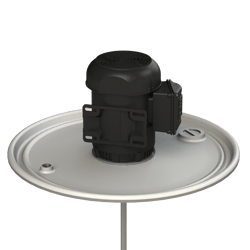
A drum lid mount is designed for mixing directly inside 55 gallon drums.
In this setup, the mixer is attached to a plate that sits on top of the open drum. The plate is secured using the standard drum closure ring that normally holds the drum lid in place. Once tightened, the mixer stays positioned over the drum while the shaft and impeller extend into the material.
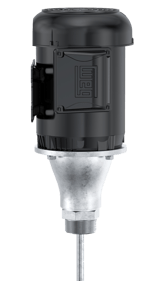
A bung mount mixer allows mixing without removing the drum lid. The mixer shaft passes through the bung opening in the lid. To make this possible, bung mount mixers use folding propellers. The blades fold as they pass through the opening and then expand once the mixer begins rotating.
This setup is useful when the container needs to remain closed or when operators want to limit product exposure.
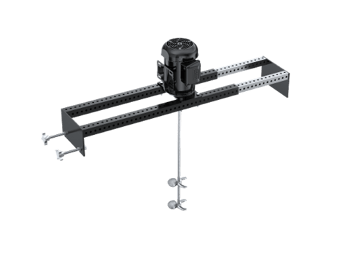
A tote mount mixer is designed for IBC tote containers.
The mixer is supported by a bracket that expands and clamps onto the outer edges of the tote frame. Once secured, the mixer sits above the tote opening while the shaft extends into the liquid or slurry inside.
This configuration allows facilities to mix directly in the tote without transferring the material to another container.
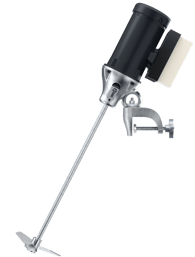
A clamp mount mixer attaches directly to the side of a container using a vice style clamp.
This mounting style makes it easy to install the mixer quickly and move it between containers when needed. Clamp mounts are commonly used for drums, small tanks, and pilot scale mixing setups.
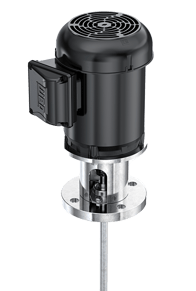
A flange mount is typically used for larger process tanks.
In this configuration, the mixer connects directly to the tank's flange opening and is bolted into place. A seal or gasket is usually installed between the mount and the tank to prevent leaks.
Flange mounts are often used in permanent mixing installations where the mixer remains attached to the tank for long production runs.
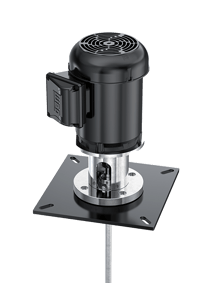
A plate mount mixer uses a flat mounting plate that can be bolted to structural supports above the tank.
Often the plate is attached to two C channels that span across the tank opening. The mixer is then mounted to the plate so the shaft extends into the vessel. This mounting style is commonly used in custom mixing setups where a standard container mount does not apply.
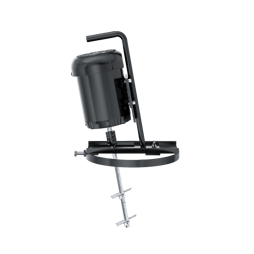
A pail mount mixer is designed for five gallon pails.
The mount attaches directly to the rim of the container and supports the mixer while the shaft and impeller extend into the material. These mixers are often used for product testing, laboratory work, or small batch mixing.
In some operations, the containers being mixed are mobile or frequently swapped out. Instead of moving the mixer from container to container, it can be more efficient to keep the mixer in one location and bring containers to it.
This is where mixer stands are useful.
A mixer stand supports the mixer above the container and allows the operator to raise and lower the mixer into different vessels. The container is placed beneath the stand, and the mixer is lowered into position when mixing begins. Once the batch is finished, the mixer can be lifted and the next container positioned underneath.
Common types of mixer stands include:
Each stand is named for the mechanism used to raise and lower the mixer. Regardless of the lifting method, stands make it easier to position the mixer safely while allowing one mixer to service multiple containers.
By this point, you’ve seen how the main components of a mixing system work together. Each piece plays a role in how effectively energy is transferred into the fluid and how stable the mixer remains during operation. Selecting the right mount or stand ensures the mixer is positioned correctly so the impeller can generate the proper flow pattern inside the container.
If you're still unsure which mounting option is best for your application, our sales engineers can help. They can review your container type, material properties, and mixing goals to recommend the right configuration.


Oftentimes, we make decisions based on finding a solution that will work for a low price. While it may not be the most optimal choice, it’ll still...

Choosing the right mixing equipment is crucial for efficient processing and product quality. One of the key factors influencing this choice is the...
Ever wonder how industries keep up with the huge demand for everyday products? Industrial mixers are a big part of the answer. Whether it’s food,...